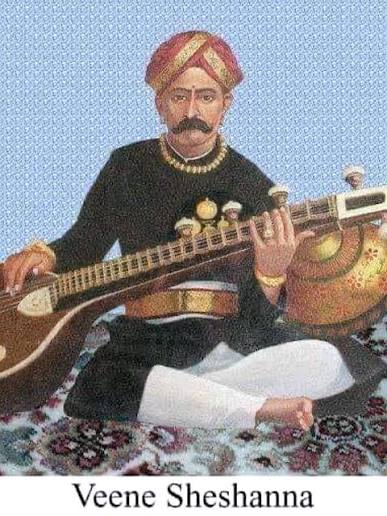
Veena Sheshanna (1852—1926)
Sheshanna was a concert musician at the court of the princely state of Mysore. Back in the days veena artistes played the Saraswati Veena holding it vertically and it was Sheshanna who played it holding it in the horizontal position for the first time. It is believed that, Sheshanna was perhaps the originator of the Mysore style of rendition. He was an exceptional composer and his profound knowledge in north Indian classical music is striking in his Tillanas.
Dhanammal (1867–1938)
Dhanammal was a highly accomplished, vocalist and a soloist performer on the Saraswati veena. She is unanimously known as Veenai Dhanammal and the prefix Veenai in her name speaks volumes about her mastery and legacy. Her systematic raga elaboration is unparalleled. Dhanammal’s style of veena rendition, is still regarded as a yardstick for tradition and depth of expression. Her supreme mastery over ‘Tanams’ (Elaboration of a musical mode set to a non-metric rhythmic pulse) is remarkable for its grandeur, perfect proportion, and refinement.
Karaikudi Subbarama Iyer (1883-1936) Karaikudi Sambasiva Iyer (1888 – 1958)
Brother duos, the seventh generation to carry the distinguished Karaikudi tradition, they were known for their stage presence, and brilliant tone of their Saraswati Veena. While Subbarama Iyer held his veena vertically and Sambasiva Iyer held his Veena horizontally. Subbarama Iyer was known for illustrating of distinct melodic improvisations on a line of text within the structure of the composition. His control over tempo was exceptional. Sambasiva Iyer was known for his outstanding exposition of Tanams.
Mysore Venkatesha Doraiswamy Iyengar (1920-1997)
One of the greatest Saraswati veena exponents of modern India. Born into a lineage of vainikas, Doraiswamy Iyengar was brought up in the royal atmosphere of Mysore palace. He is praised for his tonal purity along with his impeccable raga expanse. Doraiswamy remained a purist and stuck to the ‘acoustic’ Veena and stayed away from contact microphone. He cites, the natural tone of the Veena is lost while using a contact microphone albeit the exaggeration of the sound. Maestero is acknowledged as a notable representative of a unique “Mysore style” of veena rendition.
Emani Sankara Sastri (1922-1987)
This creative genius and integrationist hails from a family of celebrated Vainikas. His exposure to classical north Indian and classical western music has influenced his personal style. He performed duets with eminent Hindustani intrumentalists. Shankara shastri illustrated versatile expressions on the third and fourth strings of the Veena. Furthermore, he explored the Veena to create a range of sounds, including something that resembled wind instruments. His Gamakas (integral ornaments) and Tanams illustrated with ingenuity and virtuosity.
Chitti Babu (1936 – 1996)
Arguably one of the greatest Vainikas, who became a legend in his own lifetime. Continuing with the principles of his mentor’s (Emani Shankara Shastri), Chitti Babu, evolved a distinguishing identity, which is in all respects his own. The hallmarks of his unique rendition style are tonal quality and versatility. From syllables that resemble vedic hymns to mellifluous Cuckoo’s voice and even classical western. Audience finds his concertsemotionally moving.